Cascadia Sustainable Aviation Institute
Research, testing, and fuel data to make sustainable aviation fuel cheaper, cleaner, and faster to qualify.

About the Institute
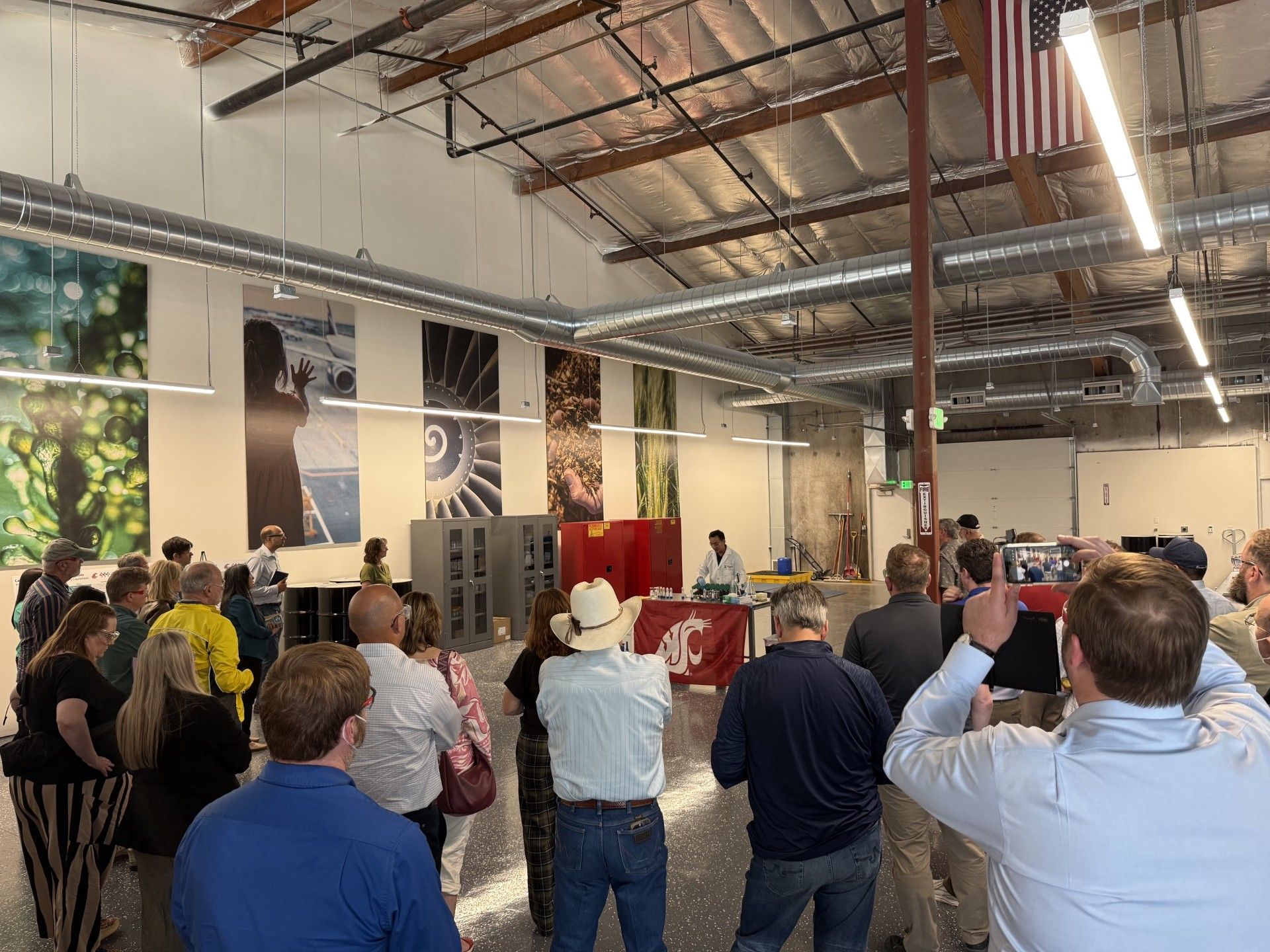
The Cascadia Sustainable Aviation Institute (CSAI) is an applied research and testing institute for the global sustainable aviation fuel (SAF) industry. Its mission is to accelerate the development and commercialization of SAF and decarbonize aviation.
Bringing a new fuel to market today takes three to five years and about $5–6 million in testing and review, often before a plant is built. ASTM D4054 phase 2 testing alone can require 100,000–450,000 liters of fuel, more than most early-stage producers can make. CSAI exists to shorten that path. It gives producers the data they need earlier, from smaller volumes, in one place.
CSAI is the research partner of the Cascadia Sustainable Aviation Accelerator (CSAA). CSAI reduces technology uncertainty, and CSAA reduces market and execution uncertainty. The Institute was established in partnership with Washington State University (WSU) and Snohomish County, with laboratories at WSU Tri-Cities and Paine Field in Everett.
Key objectives
Safety comes first. All aviation turbine fuel must meet the specification requirement for use in civil and military operated engines and aircraft. Each objective below builds on that foundation.
We partner with producers at the earliest stages of technology development, from the first milliliters of fuel through pilot-scale production, to help derisk novel pathways. This avoids costly redesigns late in development. Fuels that can be used at 100% also avoid the blending, segregated storage, and certification costs that blend limits add.

We connect detailed fuel composition to properties such as freeze point, density, ignition, and seal compatibility. That knowledge supports fully formulated 100% drop-in fuels that work in today's fleet and infrastructure.
We work on technical questions that hold back new pathways. These include qualifying co-processed fuels in existing refineries and, in a later phase, upgrading pyrolysis oils from regional feedstocks such as forest residues.

We link fuel composition to soot, ultrafine particles, and contrail formation. These emissions affect air quality near airports and the climate. The work supports large-scale engine and flight tests with well-characterized fuels.

We support the ASTM D4054 process with prescreening, specification testing, and fit-for-purpose testing. We also support a generic annex for ASTM D7566, which could let new fuels be approved by their composition and properties rather than through a full qualification for each pathway.


Core capabilities
CSAI is designed to bring the full ASTM D4054 qualification pathway together in one place. Four capabilities serve producers, manufacturers, and regulators.

Low-volume testing & 100% drop-in support
Available now (WSU Tri-Cities)
Producers send as little as a few milliliters of fuel. We analyze its composition, predict and measure key properties, and flag problems with freeze point, ignition, viscosity, or density early. The lab is FAA-designated for prescreening, and about 40 institutions worldwide have sent candidate fuels. Testing runs from microliter samples through full specification and Fast Track tests at about 25 gallons.

QA/QC testing and fuel repository
Coming soon (Paine Field, under construction)
A 60,000-gallon repository at Paine Field will receive, test, index, and distribute neat SAF components, blends, and reference jet fuel. It will supply well-characterized reference lots to manufacturers and laboratories. It will also provide the large volumes needed for rig, emissions, and contrail tests, and keep qualification samples together with their data. The facility will offer independent quality testing as SAF moves through regional terminals and airports.

Generic annex testing
Coming soon
Today each new production pathway needs its own ASTM D7566 annex. CSAI is building the tests, data, and tools to support a generic annex that approves fuels by composition and properties. The work frames open questions for the ASTM community, such as current limits on density, aromatics, and cycloparaffins, and gathers the evidence to answer them.

AI-enabled research and development
Coming soon
We are developing prediction methods that link detailed fuel composition to properties, safety, and emissions. This includes more accurate property predictions for 100% SAF and quantum chemistry calculations to build predictive spectral libraries. The goal is more answers from smaller fuel volumes, earlier in development.
Technical leadership

Joshua Heyne, Ph.D., Technical Lead, is a Battelle Distinguished Professor at Washington State University Tri-Cities, where he directs the SOAR Lab and the Bioproducts Science and Engineering Laboratory.
Dr. Heyne leads one of the world's most established fuel qualification research programs. His SOAR Lab is an FAA-designated prescreening laboratory under FAA ASCENT Project 065, and about 40 institutions worldwide have sent it candidate fuels for testing. All five U.S. engine manufacturers, along with Boeing, have partnered with the lab on fuel qualification.
He co-edited Fuel Effects on Operability of Aircraft Gas Turbine Combustors (AIAA, 2021), which draws on the FAA-led National Jet Fuels Combustion Program. WSU also co-leads the FAA ASCENT Center of Excellence with MIT.